Me and Chess
A lifetime in chess - from junior championships to chess software and endgame composition.
The person behind ChessPM has spent more than five decades in chess - as a player, International
Master, software developer, and endgame study composer.
Riga, age nine
I learned to play chess at around age nine, taught by a friend from my neighborhood in Riga,
Latvia, a few years older than me. I remember winning our very first game. Later I'd sometimes
play my uncle Misha, a rated player in Latvia at the time.
I loved the game - the depth of it, the challenge of finding the best move, every single time.
At twelve I joined a chess club near the city's ice hockey stadium, and progress came quickly:
I earned my first rank within a year. At thirteen, my family immigrated to Israel, to Beer Sheva,
where we met Eliyahu Levant, who had just opened a chess circle there. I played first board for
the Beer Sheva team, with Alon Greenfeld on second and players like Rami Tal and Amir Harel
alongside us. We started taking first places in national youth competitions - the first steps of
a club that would go on to build a reputation known around the world.
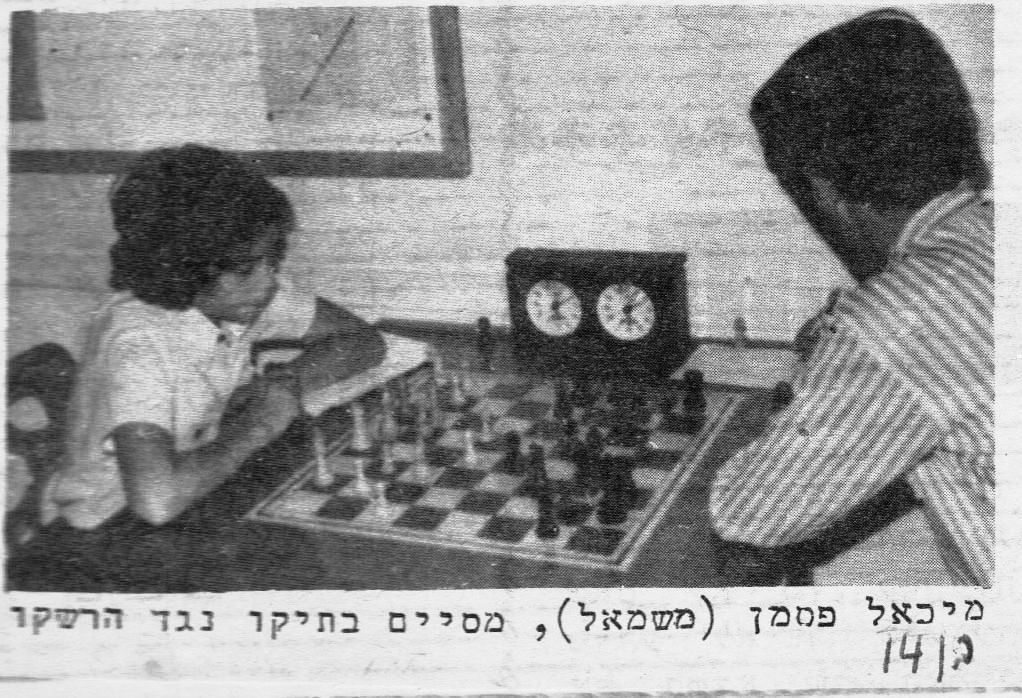
Against Abir Har-Even (Robert Hershko), shortly after arriving in Israel. I was 14 or 15.
National champion at sixteen
Chess became my main pursuit, through high school and up to military service. There was no coach
at the club, and no software to learn from back then - I studied out of books, on my own. By
sixteen or seventeen I'd reached the highest levels in the country, including winning the
national youth chess championship in 1977. At the time, I was, without much question, the
leading player among Israeli youth.
My main rival was Nir Grinberg, two years older and already a U-17 World Champion. I beat him in
a tough six-game match, earning the right to represent Israel at the World and European Junior
Championships. Once Grinberg aged out of the youth category, I found myself the leader, with
Alon Greenfeld - who had roughly 100 fewer rating points than me at the time - not far behind.
Later, after I'd mostly stepped away from competitive chess, Greenfeld kept advancing and became
one of the country's top players, eventually earning the title Champion of Israel.
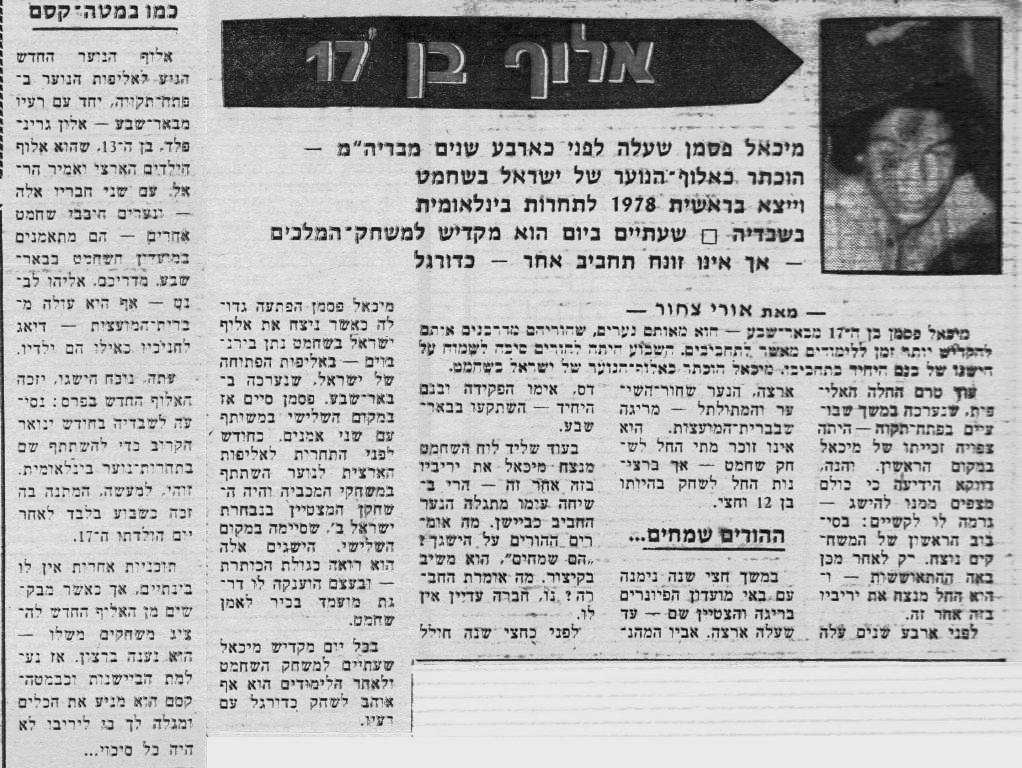
An article in "Yediot Aharonot" after winning the national youth championship.
World and European junior championships
I played several World and European Junior Championships - respectable results, usually
somewhere around 7th to 13th place, though I always did better playing at home than abroad.
In Israel, results kept coming: a 10-out-of-10 season in the national youth league (an
achievement that may never be repeated), strong finishes in the Israel Open including a win
over champion Nathan Birenboim, and two medals at the Maccabiah Games as part of Israel's youth
team - including a win over Yitzhak Radashkovich, a national team member to this day. Together,
these results pushed my Israeli rating past 2400.
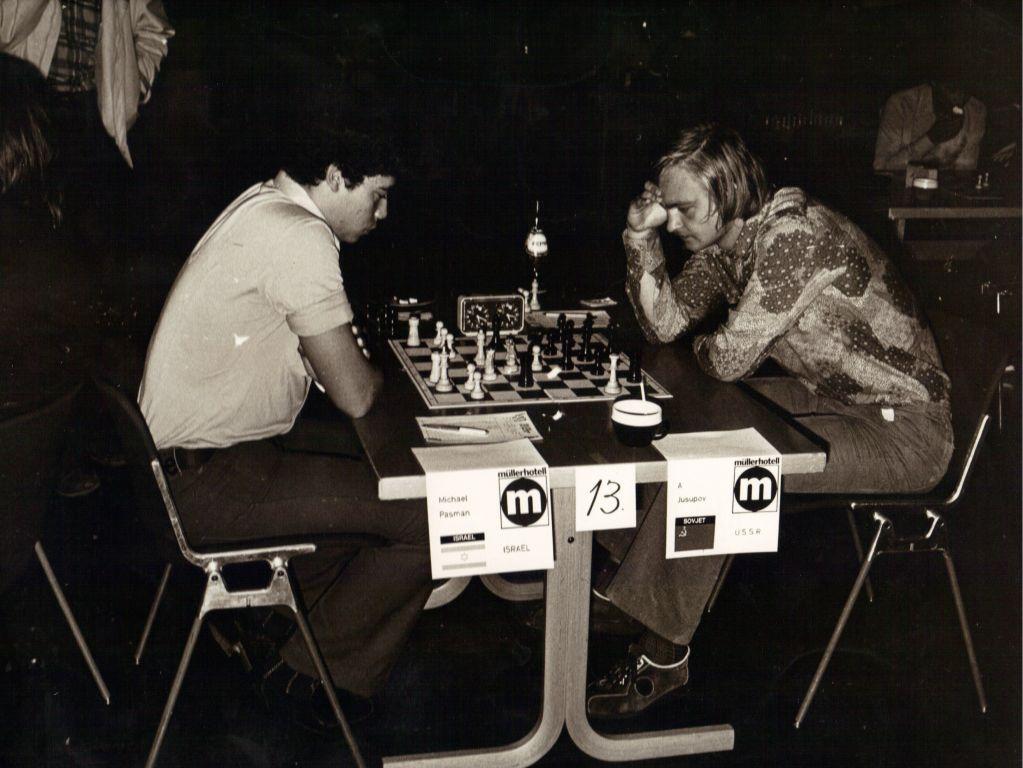
World Junior Championship, against Russia's Yusupov - a candidate to win the event. The
game was adjourned and I agreed to a draw, but his coach Mark Dvoretsky later showed me a
forced win I'd missed had I continued.
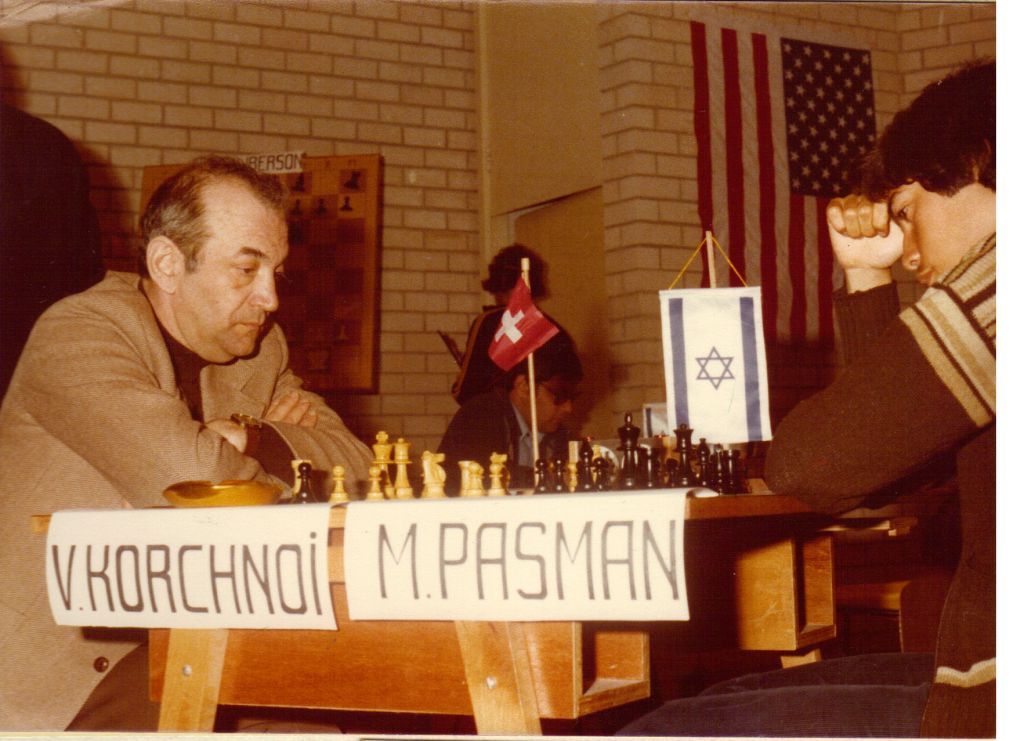
Playing Viktor Korchnoi, then exiled from the Soviet Union to Switzerland, shortly before
his World Championship match against Anatoly Karpov.
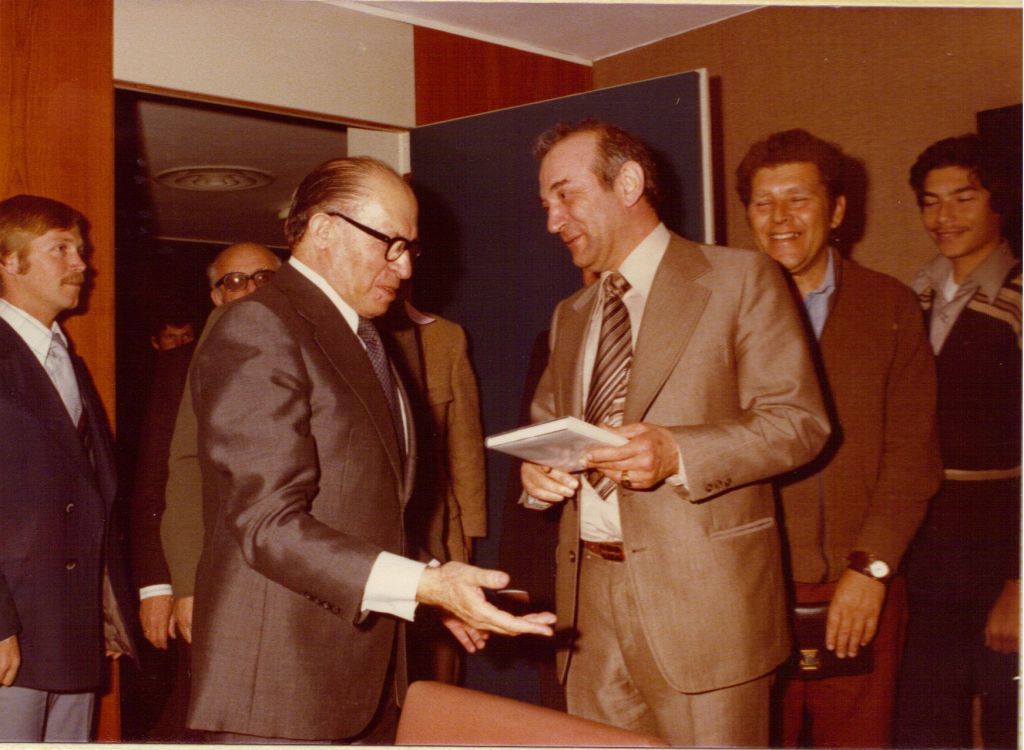
Korchnoi presenting a book to Prime Minister Menachem Begin at a reception for the
International Chess Festival in Beer Sheva. On the right - me and my father.
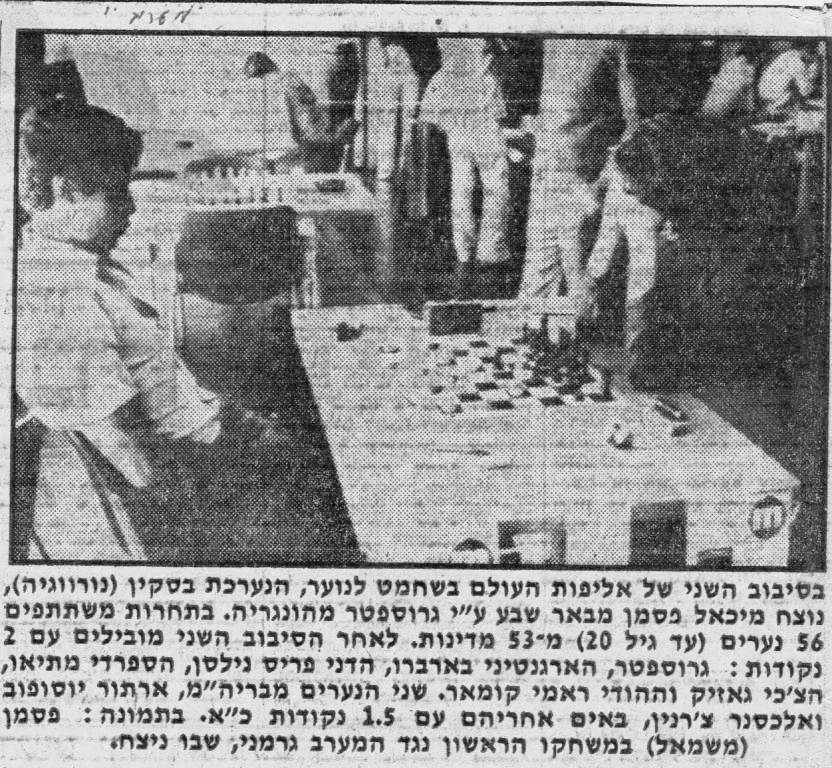
Press coverage in "Ma'ariv" of a World Championship game against Germany's Lau - I forced
resignation after just 25 moves.
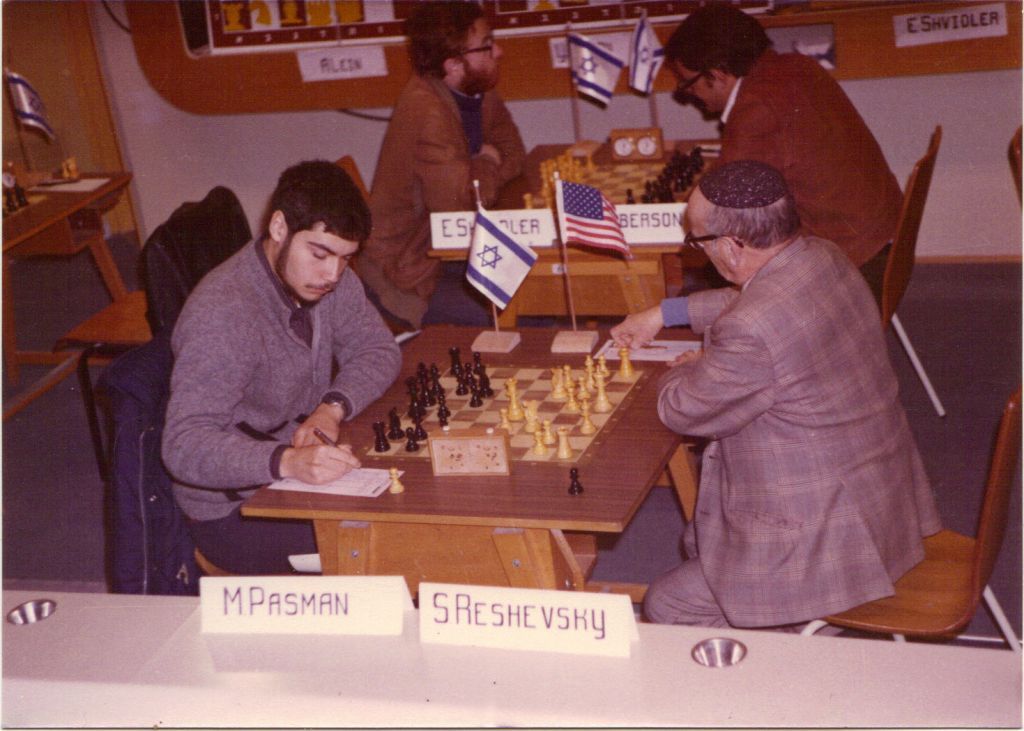
Playing Samuel Reshevsky, the American former World Championship contender. The game ended in a draw.
I never played in as many events as some of my peers - only the ones that mattered: World and
European Championships, Eliyahu Levant's international events in Beer Sheva, and league games.
I always loved being home, and the life of a traveling professional player never appealed to me.
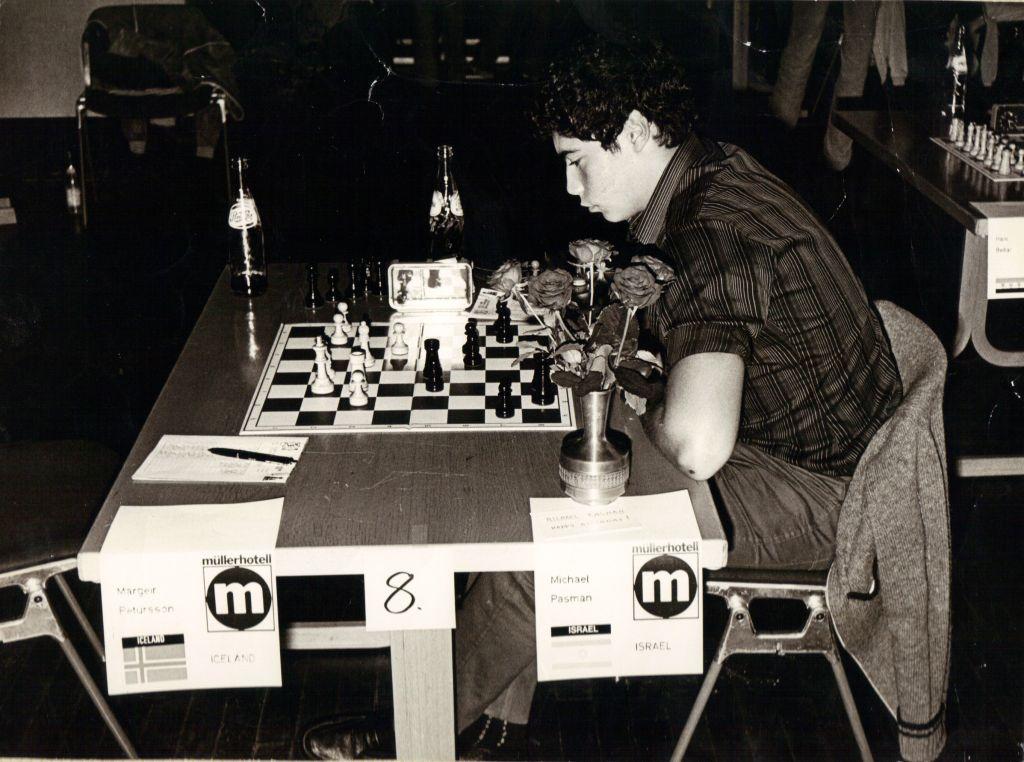
At the World Junior Championship - flowers for my birthday on August 5.
Military service - a pause, not a choice
Being drafted into the IDF at eighteen slowed my progress, to some extent unavoidably - there
was little time or support to keep training while serving. It's a hard age for any athlete to
step back for three years, and I represented Israel at World and European Junior Championships
during that period with essentially no support structure behind me - not financial support,
which I never expected, but even something as basic as coaching or time to train. Things have
since changed for the better - today's athletes get real support and consideration during their
service, which wasn't the case for my generation.
Software, a career, and ten years away from chess
Toward the end of my service I got interested in computers and software, taking courses through
the Open University. After finishing my service I went straight into graduate studies in
mathematics and computer science at Ben Gurion University. I kept playing chess on the side, and
results were still solid, but real progress requires total commitment - study, theory, constant
competition - and I simply didn't have the time for that anymore. The level I reached and held
was senior master, an International (FIDE) Master standard.
After graduating, I spent seven years as head of infrastructure and communications at the
Information Systems department of "Makhteshim," later completing an MBA in information systems
management before starting my own private business. Somewhere in that stretch, I left chess
entirely - I didn't touch a board again until 2000, a year after closing that business.
Alongside chess, another long chapter of my life was software development. Over the years, chess
and software gradually came together. For more than two decades, I have been developing my own
chess platform and website, creating tools both for my own use and for other chess players.
ChessPM grew out of this long-term project - not as a product I originally set out to build for
the market, but as something that developed over many years from my own work with chess,
programming, databases, analysis and training.
The comeback
After ten years away, I felt something was missing. I picked the game back up, spent a month or
two relearning openings and basics I'd half-forgotten, and entered a rapid chess tournament in
Petah Tikva - my first competition in a decade. Some players remembered me from years before;
many, especially newer immigrants, had never heard of me at all. Several grandmasters played in
that event too - and to everyone's surprise, including my own, I beat or drew a number of them
and finished third. There was clearly still a small fire burning, even if fitting serious chess
around a demanding career in computing - constantly learning new technology on top of everything
else - was never easy.
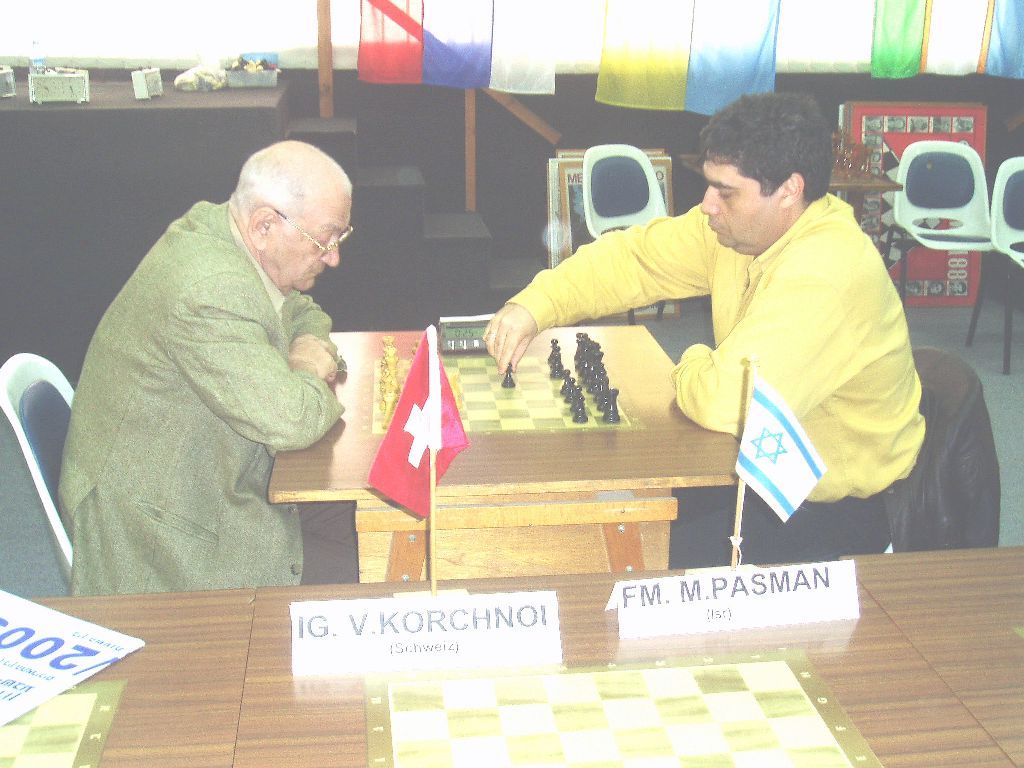
Years later - meeting Viktor Korchnoi again. Age hadn't slowed his mind, or his resolve.
International Master, 2013
I kept playing "on the back burner" over the following years - strong results in the National
League's Sunday games, deep runs in national finals, and a convincing first place at an
international event in Beer Sheva in 2005. Along the way, I earned all three norms required for
the International Master title. In October 2013, at the FIDE Congress in Estonia, it became
official: I was an International Master.
Maccabiah gold, forty years later
In 2017 I decided to play the Maccabiah again - the 20th Maccabiah, held in Jerusalem, forty
years after I'd last competed there and won two medals as part of Israel's youth team. This time
was even better: I won gold.
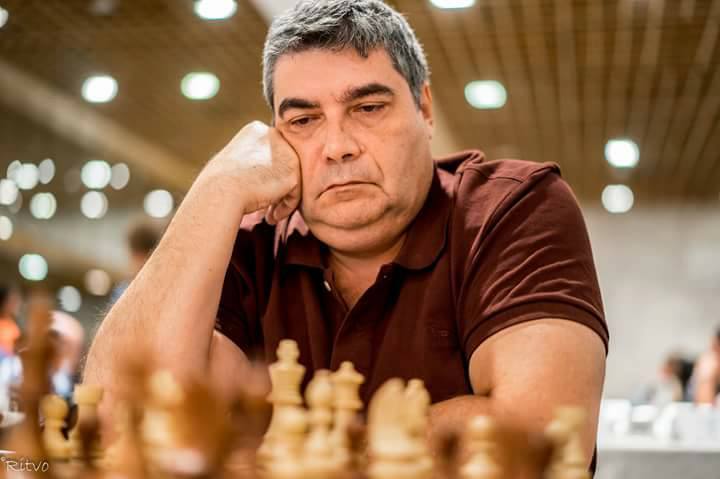
Maccabiah 2017
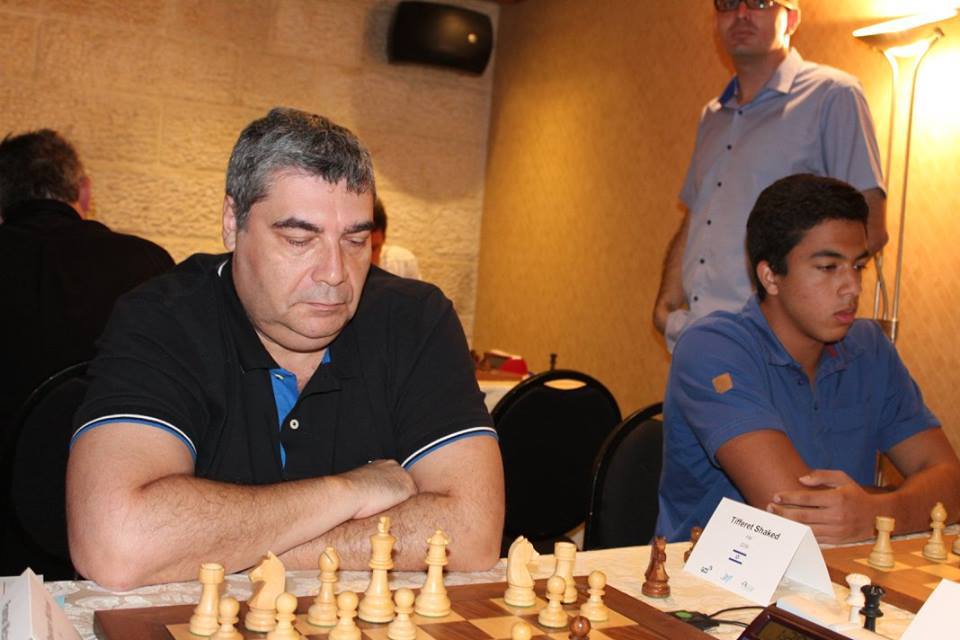
Maccabiah 2017
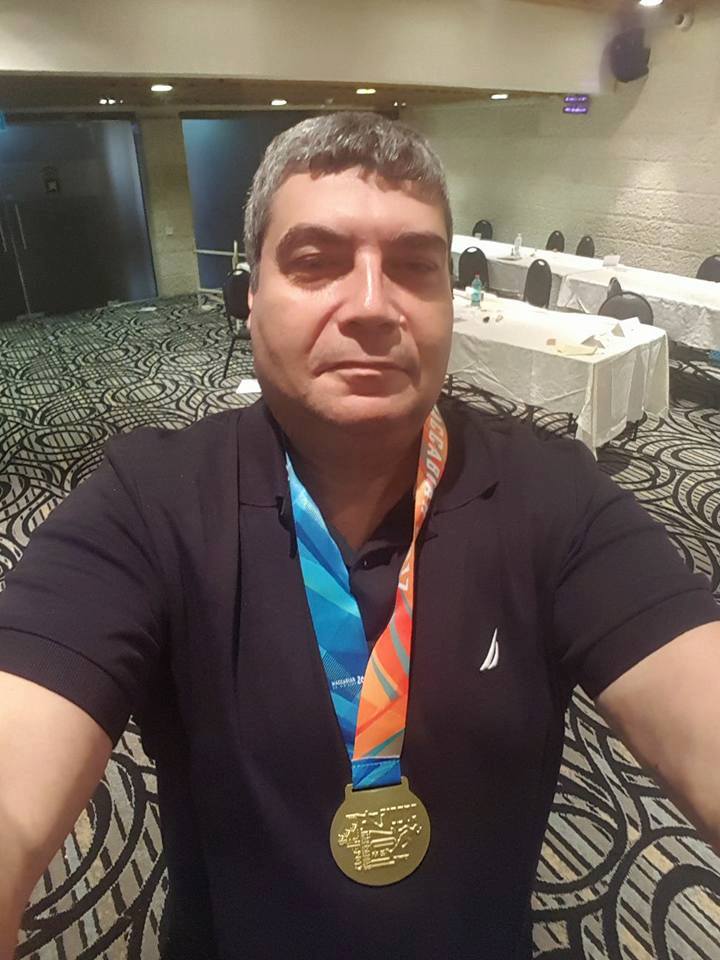
With the gold medal, Maccabiah 2017
A second chess life: composition
In 2019 I composed my first study meant for publication - I'd composed one as a young player,
but never published it. I loved the process, and kept composing studies through that year and
beyond; several placed highly, including first prizes, in significant international tournaments.
I still compose today.
In 2022, I won the FIDE World Cup for chess composition of studies for the first time.
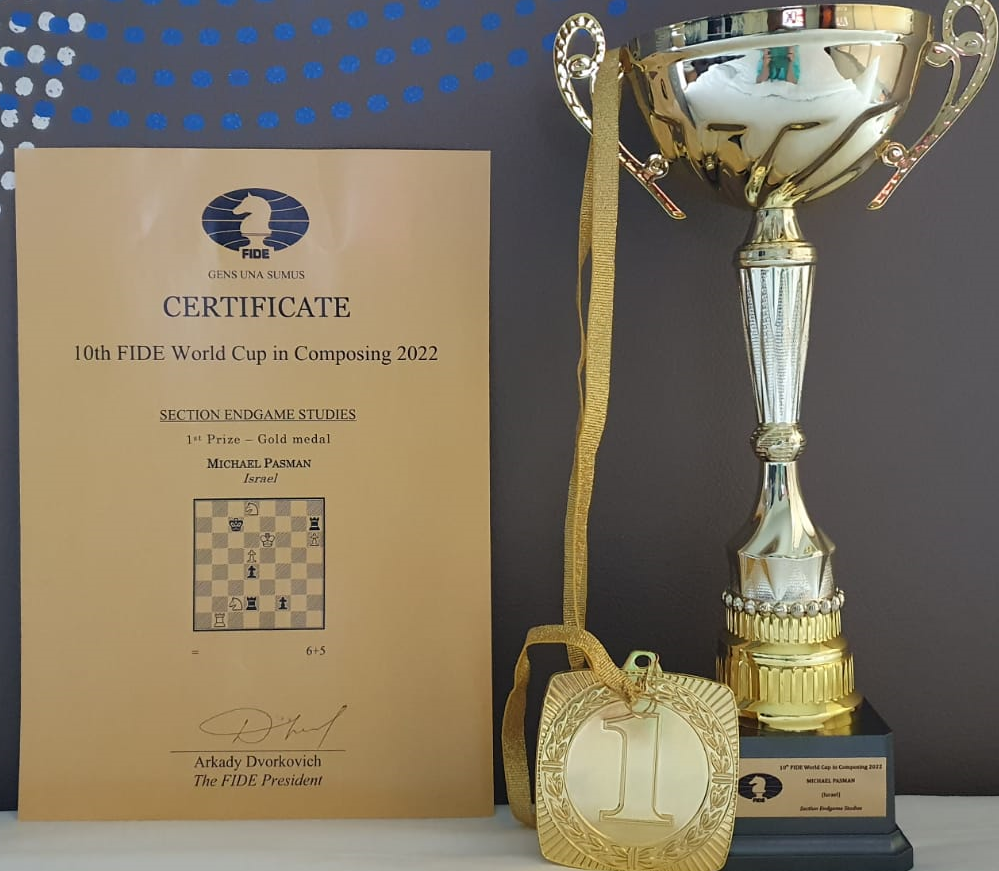
World Cup for Chess Composition, 2022.
During the WFCC 2025 Congress in Romania, I received the FIDE Master title for Chess
Composition, along with a plaque for 2nd-3rd place in the WCCI - the World Championship for
Individuals in composition, a tied result officially counted as 3rd by tiebreak.
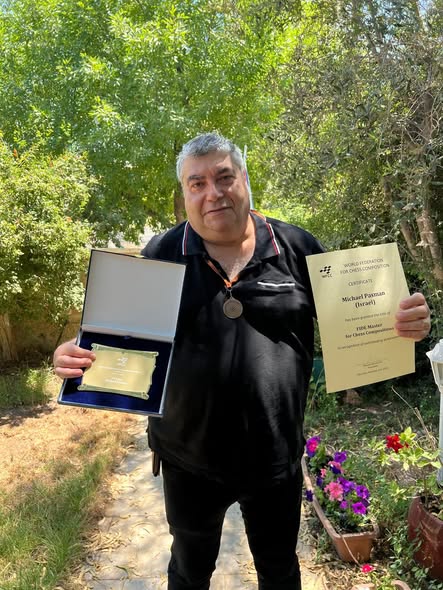
Plaque for 2nd-3rd place in the WCCI, World Championship for Individuals in composition.
In 2025 I won the FIDE World Cup for a second time - the 12th edition of the event. I received
the certificate at the WFCC Congress in 2026, in Germany.
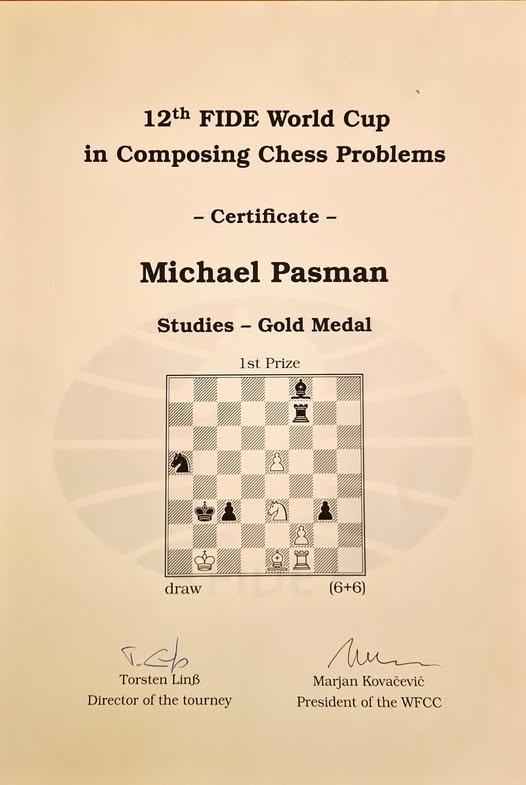
Certificate for the 12th FIDE World Cup in Chess Composition, 2025 - my second World Cup title.
Today, my work in chess continues in two directions: developing ChessPM, a training platform
for serious players, and composing endgame studies.
Explore ChessPM →